
healthcareturnaround
Healthcare is not like retail, manufacturing, hospitality, or even other service industries. Yet when financial distress hits hospitals, senior living communities, behavioral health networks, outpatient groups, or multi-facility healthcare systems, leadership teams often turn to generic turnaround strategies that were designed for completely different industries. They implement across-the-board cost cuts, freeze hiring, reduce headcount, slash discretionary spending, renegotiate vendor contracts, and apply standardized financial forecasting templates. On paper, these actions seem logical. In reality, they frequently fail in healthcare settings because they overlook the structural complexity that defines how healthcare organizations generate revenue, manage costs, maintain compliance, and sustain patient trust. The result is often predictable: margins fail to recover, liquidity tightens further, staff morale declines, quality metrics suffer, census drops, lender confidence erodes, and the organization enters a deeper cycle of instability.
The fundamental issue is not effort — it is misalignment.

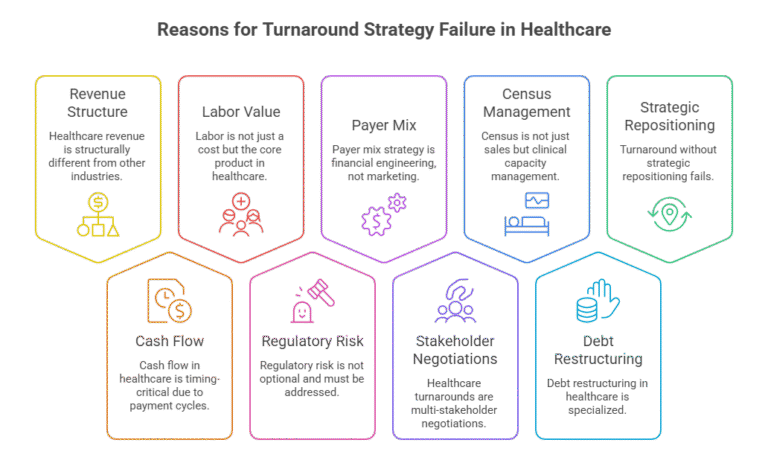
Healthcare Revenue Is Structurally Different

Healthcare requires restructuring expertise that is deeply rooted in industry-specific economics, regulatory frameworks, reimbursement systems, and operational interdependencies.
One of the primary reasons generic turnaround strategies fail in healthcare is that healthcare revenue does not behave like traditional revenue models. In most industries, revenue is calculated simply as units sold multiplied by price per unit. In healthcare, revenue is determined by a complex mix of payer categories such as Medicare, Medicaid, managed care, and private pay, each with different reimbursement methodologies, timelines, documentation standards, and compliance requirements. Revenue is influenced by case mix index, clinical documentation accuracy, authorization approvals, denial rates, value-based care adjustments, contractual rate negotiations, and regulatory compliance thresholds. A generalist consultant might suggest increasing sales volume or adjusting pricing strategies, but in many healthcare segments, pricing is regulated, reimbursement rates are negotiated in advance, and payment timing is unpredictable. Without deep healthcare expertise, advisors often misdiagnose revenue challenges as marketing issues when the real problems lie within payer mix imbalance, underperforming contracts, revenue cycle inefficiencies, or reimbursement leakage. At Skill Consultants, we approach revenue restructuring differently. We conduct payer-level profitability analysis, evaluate true reimbursement yield by contract, assess contribution margins by service line, model authorization leakage, and align revenue recognition timing with actual cash inflows. Rather than recommending surface-level revenue growth initiatives, we redesign the financial architecture of revenue to create sustainable, compliant, and predictable performance improvements.

Cash Flow in Healthcare Is Timing-Critical
Cash flow is another area where generic turnaround strategies often fall short. In healthcare, distress is rarely caused by a lack of booked revenue; it is typically driven by timing mismatches between expenses and reimbursements. Payroll must be met bi-weekly. Vendors require payment. Debt service obligations remain fixed. Meanwhile, reimbursements may be delayed due to payer processing cycles, audits, or documentation gaps. Generic advisors frequently prepare monthly forecasts or rely on accrual-based projections, which provide insufficient visibility during financial distress. Healthcare organizations require 13-week rolling cash flow forecasts, weekly liquidity monitoring, scenario-based modeling for reimbursement delays, and sensitivity analysis tied to census fluctuations. Without this level of granularity, leadership teams cannot accurately assess cash runway or negotiate effectively with lenders. Skill Consultants implements structured weekly cash control systems, payer-specific collection modeling, prioritized payables strategies, and liquidity preservation frameworks. In healthcare, survival depends not on projected profitability six months from now, but on having enough cash next Friday to meet payroll without triggering operational panic.
Turnaround Strategies Fail in Healthcare

Labor Is Not Just a Cost — It’s the Product

Labor strategy represents another critical failure point for generic turnaround approaches. In many industries, reducing headcount can quickly improve margins without severely affecting the core product. In healthcare, labor is not merely an expense category; it is the service itself. Clinical staffing ratios are regulated, quality outcomes depend on skilled personnel, and reimbursement levels are often tied to documented clinical complexity. Reducing nursing staff may reduce payroll temporarily, but it can also lead to census declines, increased adverse events, higher turnover, and escalating agency labor costs. Cutting billing staff can slow collections. Reducing compliance personnel can increase regulatory exposure. Generic cost-cutting formulas overlook these interconnected consequences. Skill Consultants applies a healthcare-specific workforce optimization methodology that includes acuity-based staffing alignment, productivity benchmarking, overtime analysis, agency cost reduction modeling, and skill-mix redesign. Our approach stabilizes labor costs while protecting care quality, regulatory compliance, and long-term revenue capacity. We do not implement blind reductions; we engineer balanced workforce realignment.

Regulatory Risk Is Not Optional

Regulatory complexity further differentiates healthcare from other industries. Hospitals, senior living operators, and behavioral health providers operate within federal and state licensing frameworks, reimbursement compliance mandates, and accreditation standards that influence operational decisions. Generic turnaround advisors may suggest service eliminations or vendor restructuring without assessing regulatory consequences, inadvertently exposing organizations to audits, penalties, or reimbursement suspensions. Deep healthcare expertise ensures that financial restructuring aligns with compliance obligations. At Skill Consultants, every cost restructuring initiative, service line adjustment, or operational redesign is evaluated through both a financial and regulatory lens, minimizing risk while preserving strategic flexibility.

Payer Mix Strategy Is Not Marketing — It’s Financial Engineering

Payer mix strategy is another area where industry fluency dramatically changes outcomes. Generic advisors often recommend increasing higher-margin private pay patients or boosting occupancy through marketing. While census growth is important, payer mix profitability requires granular modeling. Medicaid rates in some states may fall below cost. Managed care contracts can vary significantly in reimbursement yield. Private pay strategies may require differentiated service offerings or capital investment. Case mix shifts can alter reimbursement dynamics. Without detailed contract analysis and profitability modeling, organizations may grow census while still losing margin. Skill Consultants evaluates each payer category, models contract performance, identifies renegotiation opportunities, and designs revenue composition strategies that optimize financial sustainability rather than simply increasing volume.

Healthcare Turnarounds Are Multi-Stakeholder Negotiations

Healthcare restructuring also involves a broader and more complex stakeholder ecosystem than most industries. Financial distress impacts not only executives and shareholders but also lenders, bondholders, landlords (often structured as REITs), regulators, families, physicians, and community partners. Miscommunication can erode trust quickly. Generic turnaround firms frequently underestimate the political and emotional dynamics of healthcare environments. Skill Consultants integrates structured stakeholder communication plans, board-level financial dashboards, transparent liquidity models, and lender-ready restructuring proposals. By combining analytical rigor with strategic narrative clarity, we help leadership maintain credibility and secure stakeholder alignment during periods of uncertainty.

Census Is Not Just Sales — It’s Clinical Capacity Management

Census management presents another specialized challenge. In senior living, assisted living, and behavioral health networks, occupancy volatility directly affects EBITDA and liquidity. Fixed cost structures mean that even small census drops can create disproportionate financial pressure. Generic strategies often default to increasing marketing spend without analyzing break-even occupancy thresholds or capacity utilization. Our team conducts occupancy sensitivity analysis, models census recovery timelines, aligns staffing structures with occupancy bands, and evaluates referral pipeline data to create realistic financial forecasts. Census becomes a measurable financial lever rather than an unpredictable variable.

Debt Restructuring in Healthcare Is Specialized

Debt restructuring within healthcare further underscores the need for specialized expertise. Many healthcare organizations operate under real estate-backed financing, bond issuances, or multi-facility cross-collateralized debt structures. Lenders expect credible, data-backed recovery plans grounded in realistic reimbursement and labor projections. Generic advisors may present optimistic EBITDA forecasts without integrating reimbursement volatility or regulatory risk. Skill Consultants prepares scenario-tested financial models, covenant monitoring dashboards, and evidence-based restructuring proposals that withstand lender scrutiny. Credibility in negotiation often determines restructuring success, and credibility requires industry fluency.

Turnaround Without Strategic Repositioning Fails

Beyond stabilization, sustainable recovery demands strategic repositioning. Healthcare markets are evolving toward value-based care, alternative payment models, and integrated service delivery. Organizations in distress often need not only cost containment but also revenue diversification, ancillary service development, automation in financial operations, and technology integration. Generic turnaround strategies typically focus on short-term stabilization without addressing structural competitiveness. Our firm integrates fractional CFO leadership, financial automation strategies, revenue cycle optimization, and long-term strategic planning to ensure that organizations emerge stronger rather than merely solvent.

How Skill Consultants’ Healthcare Expertise Changes the Outcome

The true difference that deep healthcare restructuring expertise makes lies in diagnosis accuracy, execution precision, and long-term viability. Generic advisors see expense lines and revenue totals. Healthcare specialists understand payer behaviors, acuity dynamics, compliance constraints, and stakeholder sensitivities.

Fractional CFO-Level Financial Leadership

At Skill Consultants, we bring fractional CFO-level oversight, healthcare-specific financial modeling, liquidity protection frameworks, payer mix optimization strategies, workforce stabilization planning, and debt negotiation support tailored specifically to healthcare environments. We convert fragmented data into actionable insights, implement weekly performance dashboards, and align operational decisions with financial sustainability.

Deep Healthcare Financial Modeling

Healthcare organizations operate at the intersection of finance, regulation, clinical delivery, and community trust. Applying a generic turnaround template to such a complex ecosystem is not simply ineffective; it can be dangerous. Deep industry expertise transforms restructuring from reactive cost cutting into strategic renewal. It preserves care quality while restoring margins. It stabilizes liquidity while rebuilding stakeholder confidence. It aligns financial engineering with clinical realities. And most importantly, it ensures that the organization can continue fulfilling its mission without sacrificing long-term viability.
At Skill Consultants, we do not believe healthcare restructuring is about cutting costs. It is about rebuilding financial architecture, optimizing operational systems, protecting regulatory compliance, and engineering sustainable growth. In healthcare, expertise is not optional. It is the difference between temporary relief and true transformation.

We bring:

1.Fractional CFO-Level Financial Leadership

  • Strategic liquidity control

  • Board-ready financial reporting

  • Covenant monitoring

  • Cash runway protection

  • EBITDA stabilization strategies

2. Deep Healthcare Financial Modeling

  • 13-week rolling cash forecasts

  • Multi-scenario payer modeling

  • Occupancy sensitivity analysis

  • Labor cost optimization modeling

  • Debt restructuring simulations

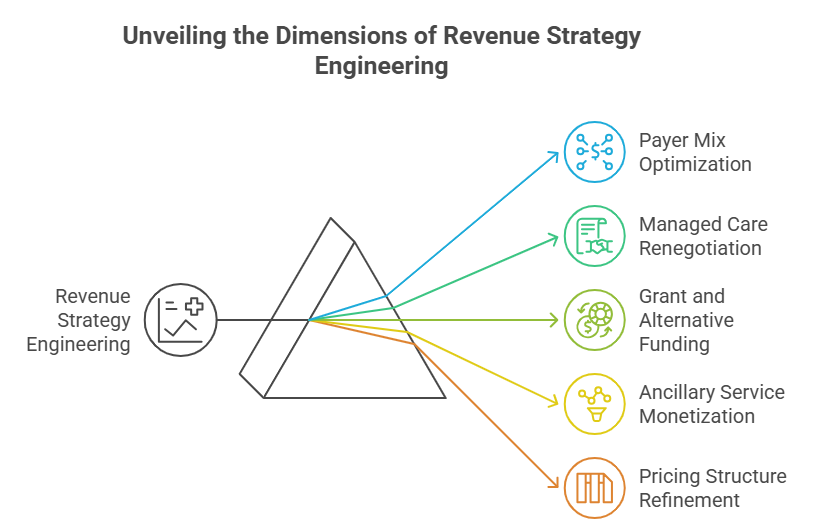
3. Revenue Strategy Engineering

  • Payer mix optimization

  • Managed care renegotiation strategy

  • Grant and alternative funding evaluation

  • Ancillary service monetization

  • Pricing structure refinement

Revenue Strategy Engineering

4. Operational & Financial Integration

  • Aligning staffing models with acuity

  • Reducing agency dependency

  • Improving revenue cycle efficiency

  • Controlling expense leakage

5. Data-Driven Decision Frameworks

We turn chaos into structured financial clarity:

  • Weekly dashboards

  • Variance tracking

  • Predictive forecasting

  • Strategic decision trees